
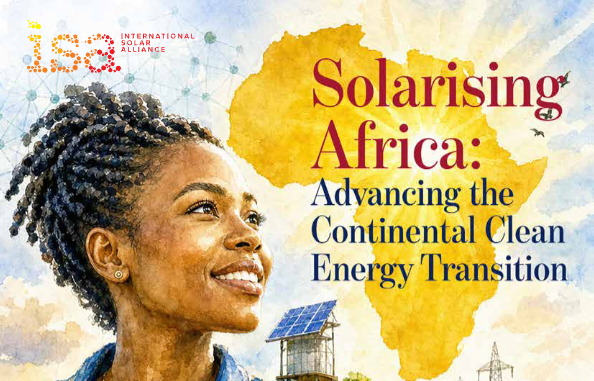

Africa possesses around 60% of the world’s solar resources, yet the continent receives only 2% of global solar investment. However, approximately 600 million people in Sub-Saharan Africa still live without access to electricity. Africa’s total installed solar capacity stood at only around 22.2 GW at the end of 2025, with 14 GW concentrated in just two countries: South Africa and the Arab Republic of Egypt. Furthermore, unreliable electricity supply costs African countries an estimated 2–4% of GDP every year.
The report co-developed by a consortium led by the International Solar Alliance (ISA), with contributions from the Regional Center for Renewable Energy and Energy Efficiency (RCREEE), Energy Transitions Commission (ETC), the Centre for Economic Transition Expertise at the London School of Economics (CETEx).
The report presents practical implementation-focused roadmaps to scale solar energy deployment across Africa to approximately 1,000 GW by 2050. It focuses on four interconnected areas:
- Distributed renewable energy to expand electricity access in remote and underserved communities.
- Solar energy for agriculture and agri-food value chains.
- Solar-powered electric transportation.
- Utility scale, interconnection, and regional integration.
The report also highlights the key enablers needed to transform plans into action, including:
- Digitalisation.
- Stronger institutions and workforce skills.
- Innovative and affordable financing.
- Local and regional manufacturing.
Read the report to explore Africa’s solar potential, understand the barriers slowing deployment, and discover practical pathways for transforming the continent’s abundant solar resources into reliable electricity, productive economies, and a cleaner future.